Published

Dec 18, 2025

Last Updated

Dec 18, 2025

IRA Vs. 401k difference: Key Points State Employees Must Know
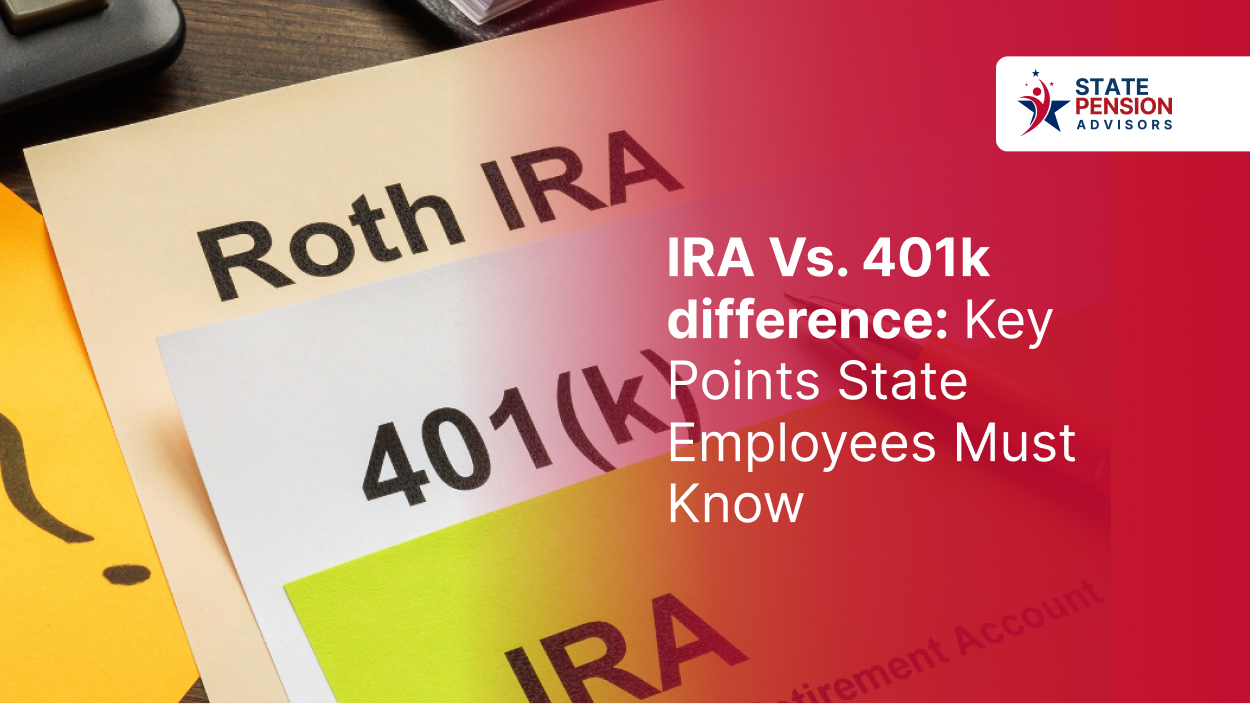
Planning for retirement is not just about saving money. It is about choosing the right tools that protect your income, reduce taxes, and support long-term financial stability. For state employees, the basic difference between the two is based on who controls the account and how it is funded. A 401k is employer-driven and structured, while an Individual Retirement Account is personal and flexible.

This guide breaks everything down clearly so you can make confident decisions about your retirement strategy.

What Is an IRA?

An Individual Retirement Account is a personal retirement savings account that you open on your own, not through your employer.

  • It allows you to save money specifically for retirement with tax advantages.

  • Contributions may be tax-deductible depending on your income and coverage.

  • Earnings grow over time and are taxed later or not taxed at all, depending on the type.

  • You can choose how your money is invested.

  • It is ideal for people who want flexibility and control.

  • Contribution limits are set yearly by the government.

  • Withdrawals usually begin after retirement age.

What Is a 401k Plan

A 401k plan is an employer-sponsored retirement savings plan offered by many state and public sector employers.

  • Contributions are taken directly from your paycheck.

  • Many employers offer matching contributions.

  • Contributions reduce your taxable income today.

  • Investment options are selected within the plan.

  • Higher contribution limits than personal retirement accounts

  • Funds are intended for long-term retirement use.

  • Early withdrawals may result in penalties.

IRA 401k Difference

  1. Account Ownership and Control
    An Individual Retirement Account is fully owned and managed by you. You decide where to open the account, how to invest the money, and when to make contributions. 

A 401k, on the other hand, is offered through your employer. The employer selects the plan provider and investment options, which means you have less control over how your money is managed.

  1. Contribution Limits and Saving Capacity
    A 401k allows significantly higher yearly contributions compared to an Individual Retirement Account. This makes a 401k more suitable for employees who want to build a larger retirement fund over time. 

Individual Retirement Accounts have lower contribution limits, which makes them better suited for supplemental retirement savings rather than primary savings.

  1. Employer Contributions and Matching
    One major difference is employer matching. Many 401k plans include employer contributions that match a portion of what you contribute. 

This is essentially additional income added to your retirement savings. Individual Retirement Accounts do not include employer contributions, meaning all savings come directly from your own income.

  1. Investment Flexibility and Choices
    Individual Retirement Accounts offer broad investment flexibility. You can choose from a wide range of stocks, mutual funds, bonds, and other investment products, depending on your provider. 

A 401k typically limits investments to a selected list chosen by the employer, which may reduce flexibility but simplifies decision-making for some employees.

  1. Eligibility and Income Considerations
    Eligibility rules differ between the two. Contributions to an Individual Retirement Account may be limited based on your income and whether you are covered by an employer retirement plan. 

A 401k usually does not restrict participation based on income, allowing employees at all income levels to contribute if the plan is offered.

  1. Withdrawal Rules and Access to Funds
    Both accounts are designed for retirement, but access rules vary. A 401k often has stricter penalties and fewer exceptions for early withdrawals. 

Individual Retirement Accounts may allow certain penalty-free withdrawals for specific life events, offering slightly more flexibility when unexpected financial needs arise.

  1. Portability and Job Changes
    An Individual Retirement Account stays with you throughout your career, regardless of job changes. 

A 401k is tied to your employer, meaning when you change jobs, you must decide whether to leave the funds, roll them over, or transfer them. This makes portability a key difference for long-term planning.

Benefits of IRA vs. 401 (k)

  1. Maximize Annual Savings Capacity
    Use a 401k when your income allows higher contributions. It supports faster retirement accumulation and is especially valuable during peak earning years when saving more now reduces future financial dependence.

  2. Always Capture Employer Matching
    If your employer offers matching in a 401k, contribute at least enough to receive the full match. This is a guaranteed return and should be prioritized before funding other retirement accounts.

  3. Use Investment Control Wisely
    An Individual Retirement Account offers broader investment choices. Use this flexibility to diversify beyond employer-selected funds and align investments with your long term risk tolerance and goals.

  4. Combine Automation With Intentional Planning
    401k payroll deductions encourage consistent saving. Individual Retirement Accounts require intention but allow precision. A rational strategy uses the convenience of a 401k and the control of an Individual Retirement Account together.

  5. Plan Taxes Across Life Stages
    Using both accounts helps manage when taxes are paid. This creates flexibility during retirement, especially when income sources and tax brackets change over time.

  6. Maintain Independence From Employment
    An Individual Retirement Account stays with you regardless of job changes. This makes it a reliable long-term asset, especially for employees planning career transitions or early retirement.

  7. Reduce Long-Term Costs
    Individual Retirement Accounts often provide access to lower-fee investments. Over decades, even small fee reductions can significantly improve retirement outcomes.

Can You Contribute to Both An Ira and 401k?

Yes, you can contribute to both an Individual Retirement Account and a 401k in the same year, and for many people, this is a smart and balanced approach to retirement planning.

Contributing to a 401k allows you to take advantage of higher contribution limits and any employer matching offered through your workplace. At the same time, contributing to an Individual Retirement Account gives you greater control over your investments and added flexibility in how your retirement money is managed.

This strategy works best when you first contribute enough to your 401k to receive the full employer match, then direct additional savings into an Individual Retirement Account.

A strong retirement plan is rarely built on one account alone. Mixing an Individual Retirement Account with a 401k allows you to balance higher savings limits, employer benefits, and personal investment control. At State Pension Advisors, we educate state employees on how to use both accounts together and create a clear, compliant strategy aligned with their benefits, income, and long-term retirement goals.

Book a consultation to get personalized guidance that protects your benefits and supports the future you are working toward.

Final Thoughts

Choosing between an Individual Retirement Account and a 401k is not about picking one over the other. It is about understanding how each fits into your long-term financial picture. When used together, they create a balance between higher savings potential, employer benefits, and personal control. With the right guidance, these accounts can work in harmony to build a retirement strategy that is stable, flexible, and aligned with the future you want to protect.

Disclaimer

This content is intended for general educational purposes only and should not be considered financial, tax, or legal advice. Retirement rules and individual financial situations vary. You should consult a qualified financial advisor or retirement professional before making decisions related to Individual Retirement Accounts or 401k plans.

FAQS

Is a 401k or an IRA better?

Neither is universally better. A 401k is better if your employer offers matching and you want higher contribution limits. An Individual Retirement Account is better if you want more investment control and flexibility. Many people benefit most from using both together.

What separates an IRA from a 401k?

The main separation is ownership and structure. An Individual Retirement Account is opened and managed by the individual, while a 401k is provided through an employer with payroll-based contributions and possible employer matching.

What is a disadvantage of having an IRA?

A key disadvantage is lower contribution limits compared to a 401k. Some Individual Retirement Accounts also have income-based eligibility rules that can limit who can contribute or receive tax benefits.

Who is eligible for an IRA?

Anyone with earned income can be eligible for an Individual Retirement Account. Eligibility for tax benefits may depend on income level and whether the individual is covered by an employer-sponsored retirement plan.

REF–

https://www.usbank.com/retirement-planning/financial-perspectives/ira-vs-401k.html

https://www.fidelity.com/viewpoints/retirement/spender-or-saver

https://www.citizensbank.com/learning/ira-vs-401k.aspx

Jeremy Haug

Jeremy contributes regularly to State Pension Advisors. With a deep understanding of state pension systems and public-sector benefits, he offers readers insights and strategies to optimize their retirement outcomes.

Need Help?

727-591-7431

info@statepension.us

Schedule Free Meeting

More blogs like this

Browse more insights similar to this topic.

IRA Vs. 401k difference: Key Points State Employees Must Know

Published

Dec 18, 2025

Last Updated

Dec 18, 2025

Planning for retirement is not just about saving money. It is about choosing the right tools that protect your income, reduce taxes, and support long-term financial stability. For state employees, the basic difference between the two is based on who controls the account and how it is funded. A 401k is employer-driven and structured, while an Individual Retirement Account is personal and flexible.

This guide breaks everything down clearly so you can make confident decisions about your retirement strategy.

What Is an IRA?

An Individual Retirement Account is a personal retirement savings account that you open on your own, not through your employer.

  • It allows you to save money specifically for retirement with tax advantages.

  • Contributions may be tax-deductible depending on your income and coverage.

  • Earnings grow over time and are taxed later or not taxed at all, depending on the type.

  • You can choose how your money is invested.

  • It is ideal for people who want flexibility and control.

  • Contribution limits are set yearly by the government.

  • Withdrawals usually begin after retirement age.

What Is a 401k Plan

A 401k plan is an employer-sponsored retirement savings plan offered by many state and public sector employers.

  • Contributions are taken directly from your paycheck.

  • Many employers offer matching contributions.

  • Contributions reduce your taxable income today.

  • Investment options are selected within the plan.

  • Higher contribution limits than personal retirement accounts

  • Funds are intended for long-term retirement use.

  • Early withdrawals may result in penalties.

IRA 401k Difference

  1. Account Ownership and Control
    An Individual Retirement Account is fully owned and managed by you. You decide where to open the account, how to invest the money, and when to make contributions. 

A 401k, on the other hand, is offered through your employer. The employer selects the plan provider and investment options, which means you have less control over how your money is managed.

  1. Contribution Limits and Saving Capacity
    A 401k allows significantly higher yearly contributions compared to an Individual Retirement Account. This makes a 401k more suitable for employees who want to build a larger retirement fund over time. 

Individual Retirement Accounts have lower contribution limits, which makes them better suited for supplemental retirement savings rather than primary savings.

  1. Employer Contributions and Matching
    One major difference is employer matching. Many 401k plans include employer contributions that match a portion of what you contribute. 

This is essentially additional income added to your retirement savings. Individual Retirement Accounts do not include employer contributions, meaning all savings come directly from your own income.

  1. Investment Flexibility and Choices
    Individual Retirement Accounts offer broad investment flexibility. You can choose from a wide range of stocks, mutual funds, bonds, and other investment products, depending on your provider. 

A 401k typically limits investments to a selected list chosen by the employer, which may reduce flexibility but simplifies decision-making for some employees.

  1. Eligibility and Income Considerations
    Eligibility rules differ between the two. Contributions to an Individual Retirement Account may be limited based on your income and whether you are covered by an employer retirement plan. 

A 401k usually does not restrict participation based on income, allowing employees at all income levels to contribute if the plan is offered.

  1. Withdrawal Rules and Access to Funds
    Both accounts are designed for retirement, but access rules vary. A 401k often has stricter penalties and fewer exceptions for early withdrawals. 

Individual Retirement Accounts may allow certain penalty-free withdrawals for specific life events, offering slightly more flexibility when unexpected financial needs arise.

  1. Portability and Job Changes
    An Individual Retirement Account stays with you throughout your career, regardless of job changes. 

A 401k is tied to your employer, meaning when you change jobs, you must decide whether to leave the funds, roll them over, or transfer them. This makes portability a key difference for long-term planning.

Benefits of IRA vs. 401 (k)

  1. Maximize Annual Savings Capacity
    Use a 401k when your income allows higher contributions. It supports faster retirement accumulation and is especially valuable during peak earning years when saving more now reduces future financial dependence.

  2. Always Capture Employer Matching
    If your employer offers matching in a 401k, contribute at least enough to receive the full match. This is a guaranteed return and should be prioritized before funding other retirement accounts.

  3. Use Investment Control Wisely
    An Individual Retirement Account offers broader investment choices. Use this flexibility to diversify beyond employer-selected funds and align investments with your long term risk tolerance and goals.

  4. Combine Automation With Intentional Planning
    401k payroll deductions encourage consistent saving. Individual Retirement Accounts require intention but allow precision. A rational strategy uses the convenience of a 401k and the control of an Individual Retirement Account together.

  5. Plan Taxes Across Life Stages
    Using both accounts helps manage when taxes are paid. This creates flexibility during retirement, especially when income sources and tax brackets change over time.

  6. Maintain Independence From Employment
    An Individual Retirement Account stays with you regardless of job changes. This makes it a reliable long-term asset, especially for employees planning career transitions or early retirement.

  7. Reduce Long-Term Costs
    Individual Retirement Accounts often provide access to lower-fee investments. Over decades, even small fee reductions can significantly improve retirement outcomes.

Can You Contribute to Both An Ira and 401k?

Yes, you can contribute to both an Individual Retirement Account and a 401k in the same year, and for many people, this is a smart and balanced approach to retirement planning.

Contributing to a 401k allows you to take advantage of higher contribution limits and any employer matching offered through your workplace. At the same time, contributing to an Individual Retirement Account gives you greater control over your investments and added flexibility in how your retirement money is managed.

This strategy works best when you first contribute enough to your 401k to receive the full employer match, then direct additional savings into an Individual Retirement Account.

A strong retirement plan is rarely built on one account alone. Mixing an Individual Retirement Account with a 401k allows you to balance higher savings limits, employer benefits, and personal investment control. At State Pension Advisors, we educate state employees on how to use both accounts together and create a clear, compliant strategy aligned with their benefits, income, and long-term retirement goals.

Book a consultation to get personalized guidance that protects your benefits and supports the future you are working toward.

Final Thoughts

Choosing between an Individual Retirement Account and a 401k is not about picking one over the other. It is about understanding how each fits into your long-term financial picture. When used together, they create a balance between higher savings potential, employer benefits, and personal control. With the right guidance, these accounts can work in harmony to build a retirement strategy that is stable, flexible, and aligned with the future you want to protect.

Disclaimer

This content is intended for general educational purposes only and should not be considered financial, tax, or legal advice. Retirement rules and individual financial situations vary. You should consult a qualified financial advisor or retirement professional before making decisions related to Individual Retirement Accounts or 401k plans.

FAQS

Is a 401k or an IRA better?

Neither is universally better. A 401k is better if your employer offers matching and you want higher contribution limits. An Individual Retirement Account is better if you want more investment control and flexibility. Many people benefit most from using both together.

What separates an IRA from a 401k?

The main separation is ownership and structure. An Individual Retirement Account is opened and managed by the individual, while a 401k is provided through an employer with payroll-based contributions and possible employer matching.

What is a disadvantage of having an IRA?

A key disadvantage is lower contribution limits compared to a 401k. Some Individual Retirement Accounts also have income-based eligibility rules that can limit who can contribute or receive tax benefits.

Who is eligible for an IRA?

Anyone with earned income can be eligible for an Individual Retirement Account. Eligibility for tax benefits may depend on income level and whether the individual is covered by an employer-sponsored retirement plan.

REF–

https://www.usbank.com/retirement-planning/financial-perspectives/ira-vs-401k.html

https://www.fidelity.com/viewpoints/retirement/spender-or-saver

https://www.citizensbank.com/learning/ira-vs-401k.aspx

Jeremy Haug

Jeremy contributes regularly to State Pension Advisors. With a deep understanding of state pension systems and public-sector benefits, he offers readers insights and strategies to optimize their retirement outcomes.

© 2024 State Pension Advisors. All Rights Reserved.